









Sony exhibited its XYN™ solutions at the “Unity Industrial DX Conference 2026,” held on June 9, 2026, at TODA Hall & Conference Tokyo. Now in its fourth year, this event is an exhibition and networking forum where the industry as a whole shares advanced use cases of Unity (Unity Technologies Japan Co., Ltd.) and digital twin initiatives across industrial sectors such as automotive, manufacturing, and construction.
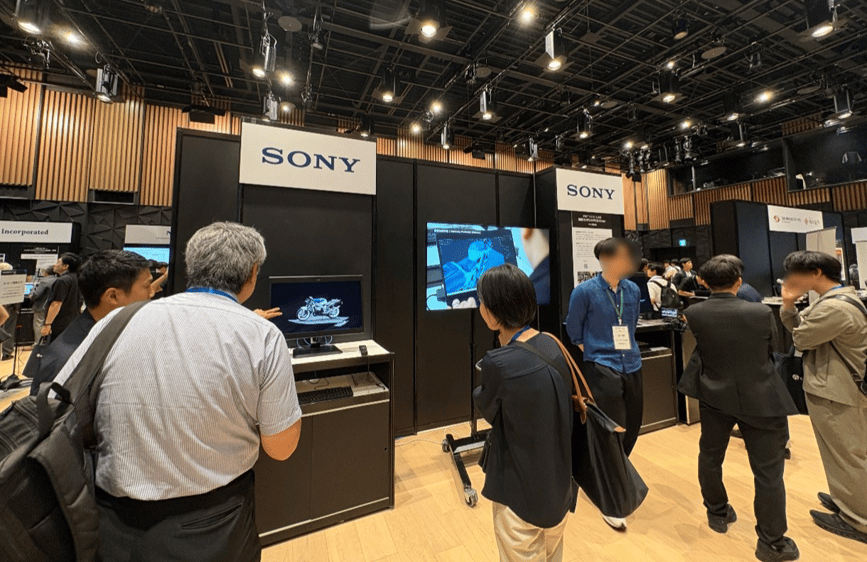
In the fields of manufacturing design and product development, there is a growing need to make better use of 3DCG data in practical work. However, many people likely feel that the cost of producing high-precision 3DCG data and the challenges of actually applying it present significant hurdles. As a solution to these challenges, Sony proposes XYN’s spatial capture solution. This system goes beyond mere capture and generation; it supports efficiency throughout the entire workflow, from display to practical application in day-to-day operations.
In this exhibition report, we’ll share details about the specific exhibits and presentations that bring digital transformation (DX) to manufacturing sites to life, along with highlights from the event.
Introduction to the Exhibition Booth
Converting Real-World Products into High-Quality 3DCG Assets for Use in Design | Honda Case Study Exhibition
At this year’s Sony booth, we conducted a demonstration of high-quality mesh generation using actual data from Honda Motor Co., Ltd. (hereinafter “Honda”) motorcycles, showing how real-world products can be converted directly into 3DCG assets usable for design and development.
This was a practical Industry DX exhibition aimed at design and development departments in the manufacturing sector, including the automotive and motorcycle industries. We presented detailed motorcycle mesh data generated from actual product data and demonstrated that even complex parts—such as the underside of the vehicle and wiring harnesses—can be reproduced with a quality high enough to withstand design reviews and simulations. Using a comprehensive setup unique to Sony—which supports the entire process from capture to generation and utilization—we provided a concrete demonstration of how 3DCG data can be leveraged on the manufacturing floor.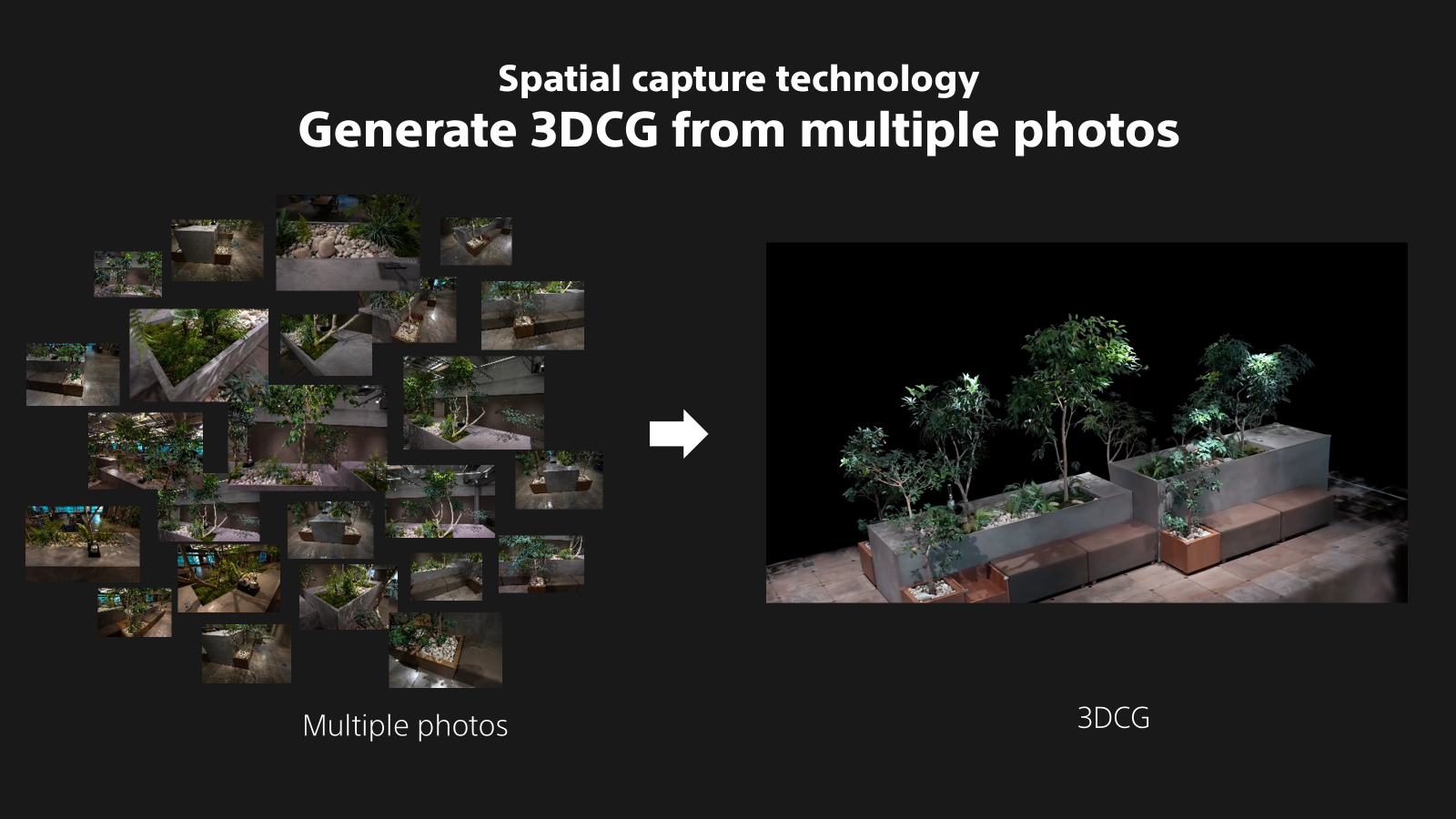
Presenting the Big Picture of the Solution Through Spatial Reality Displays and Video
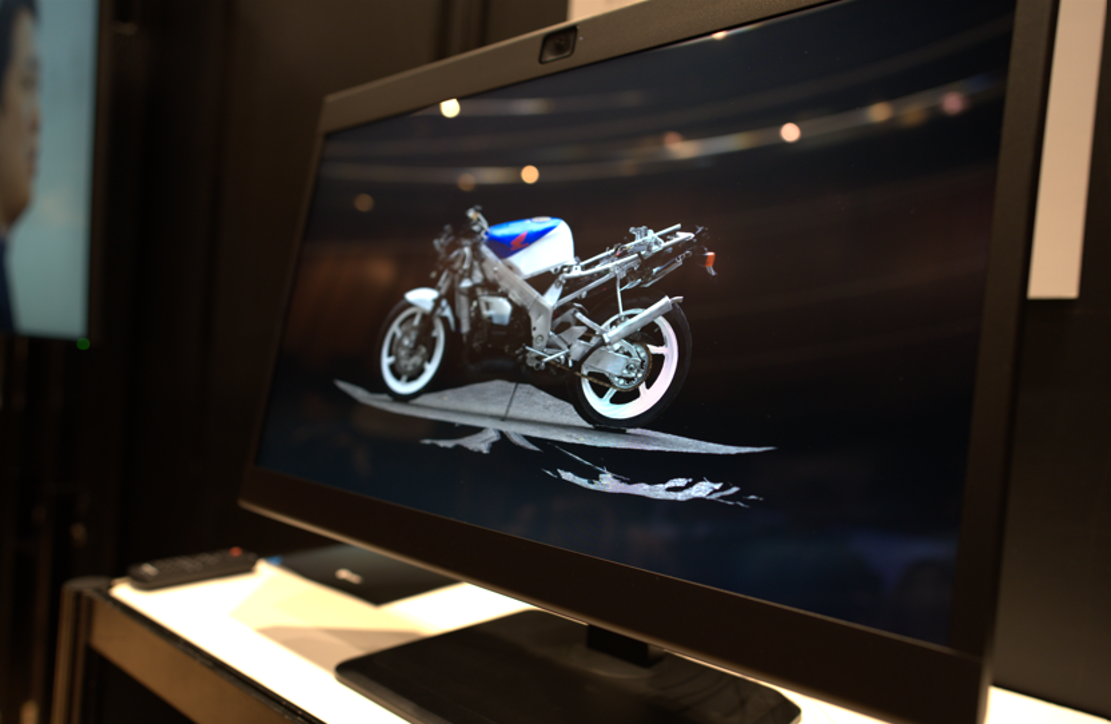
At the booth, to allow visitors to experience firsthand how the generated 3DCG assets are used in practical applications, we displayed a Honda motorcycle using Sony’s proprietary Spatial Reality Display (SRD), which enables glasses-free 3D viewing.
We demonstrated that 3D models, which are virtually indistinguishable from the real thing, can be viewed in 3D and used directly for product design reviews and simulations. We explained how stakeholders can share realistic images of the finished product from the design stage onward, enabling accurate verification even before a physical prototype is available.
In addition, we provided introductory videos on 2D monitors and VR experiences, presenting the entire workflow—from capture and generation to utilization on various devices—as a single, integrated process.
Session
Industrial Visualization Using Spatial Capture Solutions
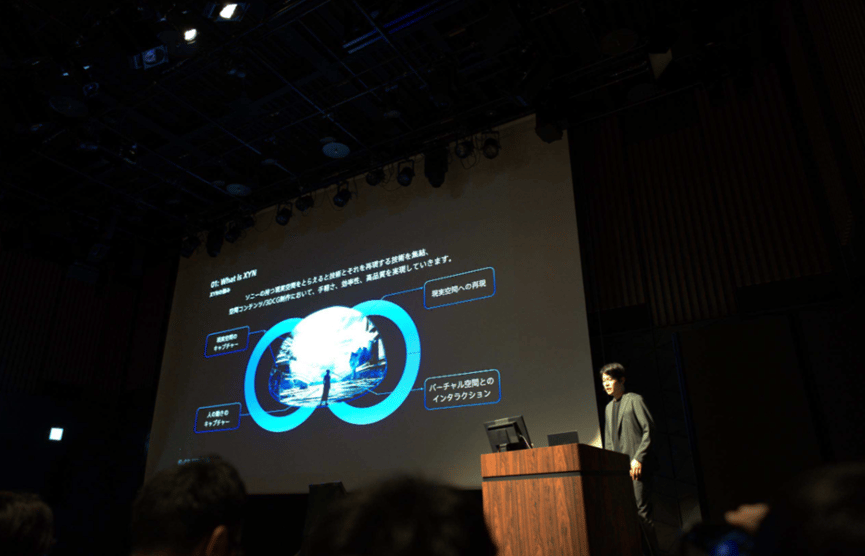
On the day of the event, Takuma Shiotsuki from our company took the stage to introduce XYN’s solutions for the industrial sector. Here are the main topics covered in the presentation.
1. Overview and Product Lineup of “XYN,” Which Provides Comprehensive Support for Spatial Content Creation
XYN is a suite of integrated software and hardware solutions designed to support spatial content creation. It uses Sony’s proprietary technology to accurately capture real-world spaces and, when combined with a wide range of external tools such as Unity, enables the creation of flexible workflows. Centered on ease of use, efficiency, and high quality, this product suite provides comprehensive support for creators’ production environments.
2. Differences Between 3D Gaussian Splatting and Conventional Mesh Methods, and Cost-Saving Benefits
Spatial capture methods include traditional mesh (polygon) techniques and methods such as “3D Gaussian Splatting (hereinafter 3DGS),” which has garnered attention in recent years. The latter method represents appearance using clusters of points and ellipses, enabling the rapid reproduction of photorealistic imagery with lightweight data. XYN offers algorithms tailored to specific use cases, allowing you to choose between 3DGS and mesh* generation.
*Mesh generation is available as a beta feature (as of July 10, 2026)
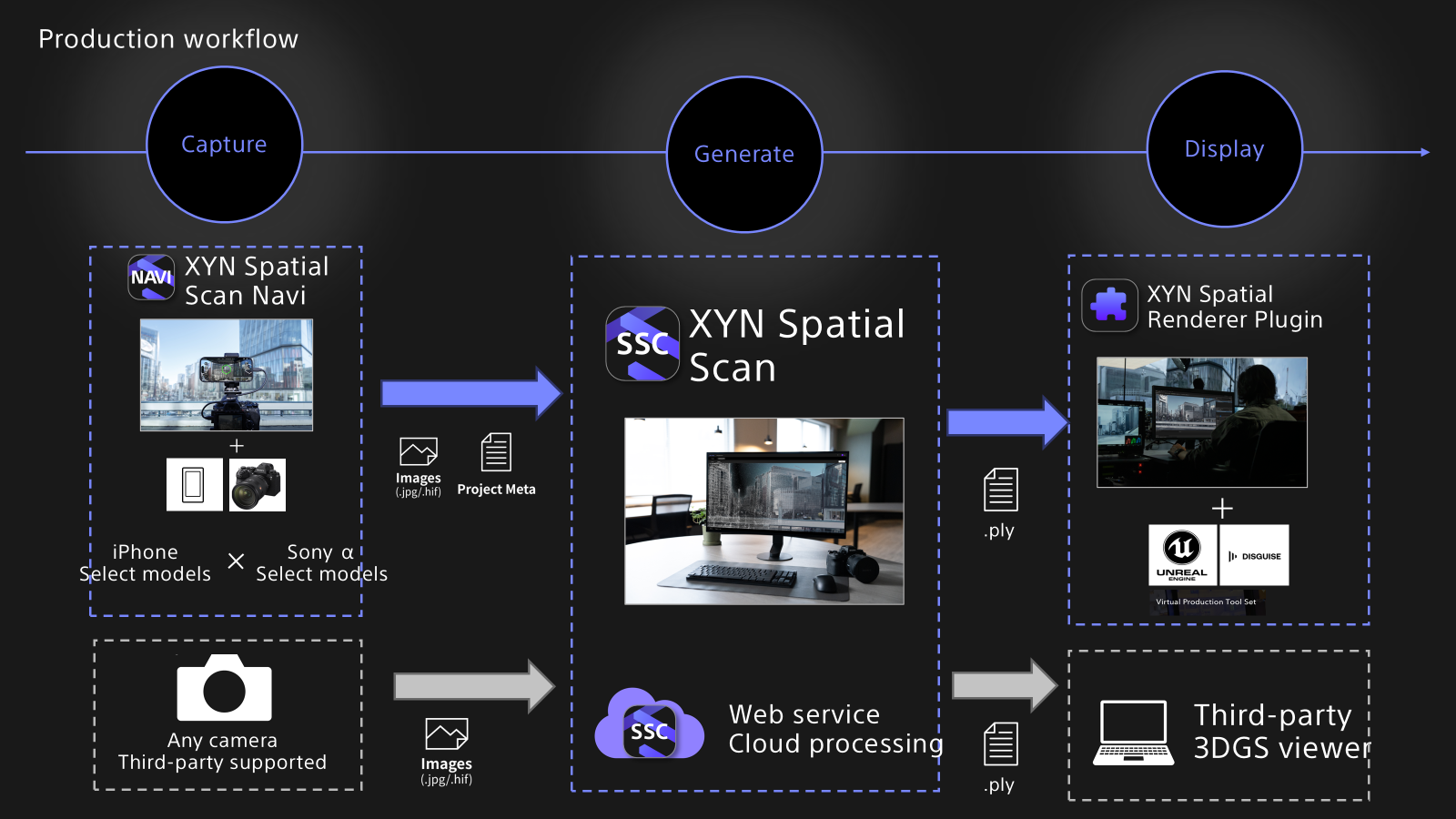
We have introduced XYN’s algorithms and the features of XYN Spatial Scan.
-
-
Production-Quality Rendering
It reproduces scenes at such high resolution that they are indistinguishable from real spaces and supports large LED wall displays. Floater noise and color unevenness are automatically corrected, ensuring seamless reproduction from near to far—including transparent subjects like glass, glossy materials, fine details such as handrails, and even distant clusters of buildings—which were previously difficult to capture with conventional photogrammetry. -
Ease of Use with No Configuration Required
You can select Sony’s proprietary algorithms based on your production goals and begin rendering in just a few steps without adjusting any parameters. Since processing is performed in the cloud—independent of PC performance—the service can be used stably in any environment. -
High Compatibility with Existing Workflows
It supports a wide range of cameras and integrates seamlessly with existing pipelines and the XYN product family. By connecting the process from capture to generation and utilization, it streamlines production and reduces the time and effort needed for shape correction and post-processing.
-
3. “Honda Motanion”: A Case Study Featuring Honda Motorcycles and Three Key Benefits for Industrial Settings
As a concrete example of its application, we introduced “Honda Motanion,” a project that created 3DCG models of iconic Honda motorcycles symbolizing the company’s history and exhibited them in a virtual space (VRChat). Since no 3D design data exists for vehicles from decades ago, the traditional approach required either creating models from scratch based on photographs or relying on photogrammetry—a method that often yields inconsistent quality due to low-light conditions and complex parts. We resolved this challenge by scanning the actual vehicles using spatial capture to obtain the geometric data that serves as the foundation for production. This initiative yielded the following three benefits that are relevant to industrial settings:
-
- No specialized training required
While 3DCG creation previously required the skills of a specialized department, the barriers to entry—from shooting to generation—have been lowered, allowing departments on the production floor to utilize spatial content without needing special skills. - Focus of Operational Resources
Previously, a significant amount of time was spent on “structural verification”—reconstructing 3D models from photographs. With shape data now available as a foundation, resources can be concentrated on high-value-added processes such as refining details and reviewing designs. - Faster Reviews and Decision-Making
The starting point has shifted from “speculation” to “acquired geometry,” allowing all stakeholders to share the same spatial information. This enables faster and more accurate reviews and decision-making.
- No specialized training required
4. Seamless Integration with Unity Tools (Asset Manager / Studio) and Future Outlook
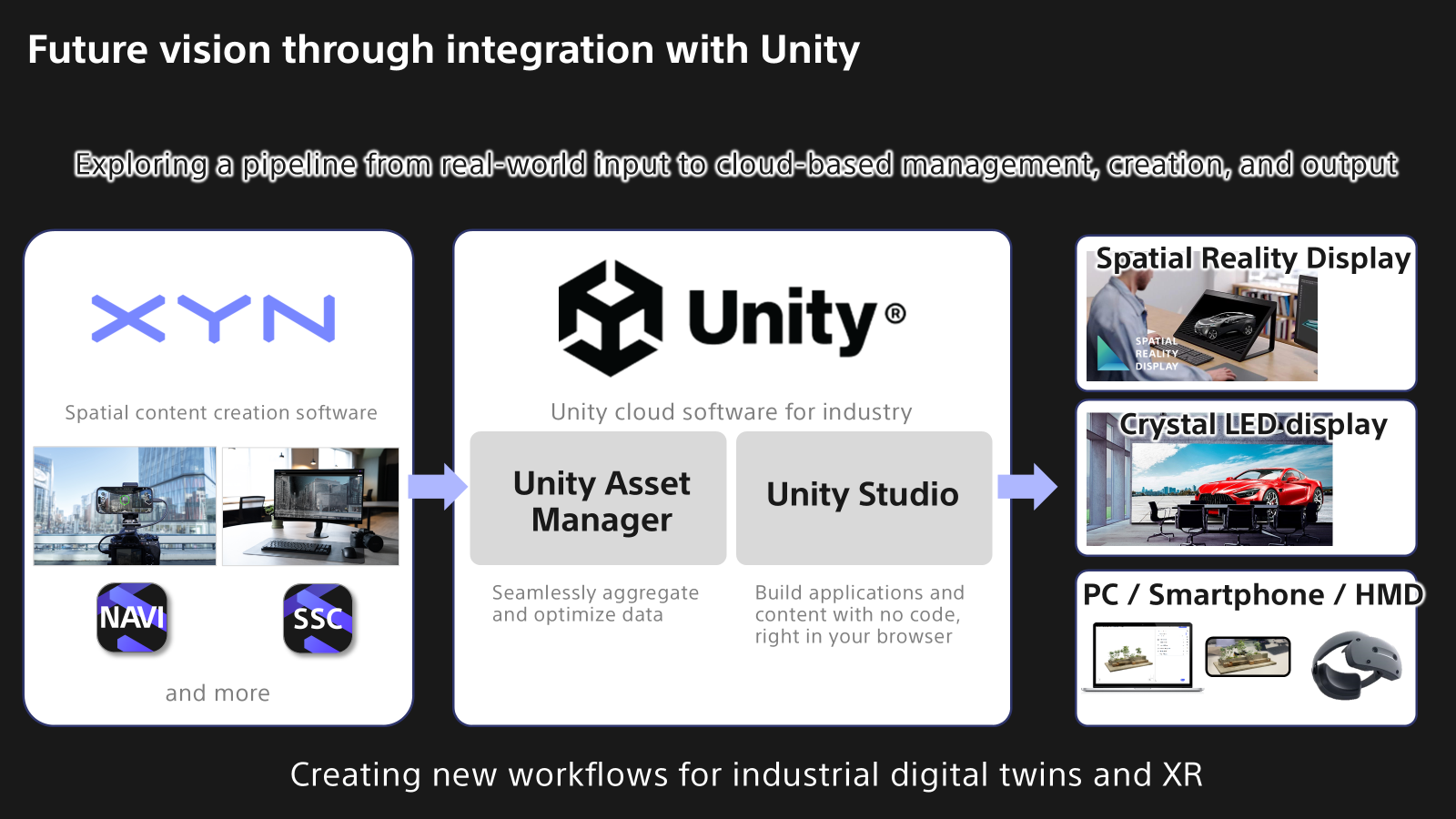
Looking ahead, we discussed the development of a pipeline that integrates with “Unity Asset Manager,” Unity’s cloud-based software for industry, and “Unity Studio,” a web-based 3D editor.
- Data captured by the shooting support app is processed by “XYN Spatial Scan” in the cloud, and then seamlessly aggregated and optimized through various Unity tools.
- This enables no-code application development in a web browser and output to various devices, including Spatial Reality displays. We outlined our strategy to create new workflows for building digital twins and leveraging XR in industry by combining these technologies.
Co-creating the Future of Industrial Digital Transformation with Manufacturing Sites
While 3DCG production has traditionally required specialized technical skills and know-how, XYN’s spatial content creation solution alleviates on-site constraints by connecting the entire process—from capture to generation and utilization. We plan to continue supporting smoother design and development workflows by integrating with platforms such as Unity.
 Thank you for attending!
■Event Overview
Event Name: Unity Industrial DX Conference 2026
Date: Tuesday, June 9, 2026
Venue: TODA Hall & Conference Tokyo
■Related Links
Unity Industrial DX Conference 2026
XYN Spatial Capture Solution
Spatial Reality Display | Sony
■XYN Newsletter
XYN Newsletter Subscribe *Residents of the USA and Canada
■XYN Social Media Accounts